
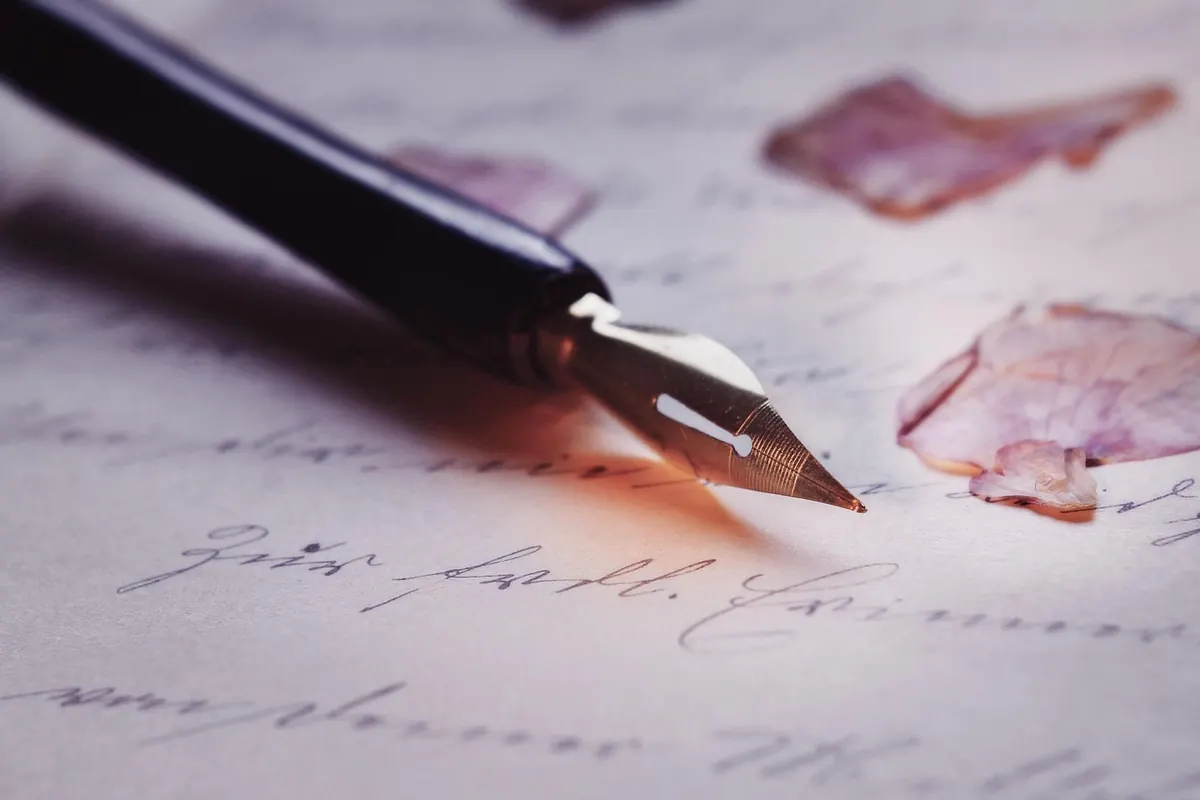
A photograph of a 1940s celluloid pen under warm light can make almost anything look collectible. What the photograph rarely shows is the hairline in the cap lip, the sac that hardened into a brittle curl sometime in the 1990s, or the nib that was "smoothed" by someone with good intentions and a coarse stone. Buying online means buying on evidence, and the evidence usually arrives as six photos and forty words of description. So here is the order in which to examine it: twelve points, arranged roughly the way you should work through a pen, starting at the part that touches paper and ending with the parts you can't see at all.
Start Where the Pen Meets the Paper
1. Look closely at the tipping
The tipping material — the small pellet of hard alloy welded to the end of the nib — is what wears out, and it is what cannot be replaced without specialist work. Ask for a straight-on shot from above and one from the side. You want to see two even tines meeting at a clean point, with the pellet intact on both. A flat worn facet, one tine longer than the other, or a tip that has worn through to the softer gold beneath all mean the same thing: this nib needs someone else's hands before it writes well.
2. Check alignment, spring, and cracks
The slit should run clean from the tip to the breather hole, with the tines level. A visible gap at the point suggests a sprung nib, often the result of a previous owner pressing too hard to coax ink out. Then follow the metal outward. Cracks starting at the breather hole or running in from the shoulder are repairable, but they change what the pen is worth to you. If the seller's photos stop just short of the nib's base, that is worth noticing.
3. Read the writing sample, or ask for one
A seller who inks the pen, writes a few lines, and photographs the result is handing you real information: line consistency, flow, whether the nib scratches or railroads. If no sample is shown, ask. A pen that writes dry might only need a flush and a wetter ink; a pen that skips in a photograph will likely skip on your desk too.
Understand the Filling Mechanism Before You Fall in Love
4. Identify the filler, and treat rubber as a consumable. Lever fillers, button fillers, and most 1950s school pens run on a latex sac. Sacs perish. A hardened sac in a pen that sat in a drawer for thirty years is normal wear, not a defect, and replacing one is routine work. Pistons, vacumatic diaphragms, and Sheaffer's vacuum fillers are a different proposition: they need someone who has done that specific job before, and the parts are less forgiving.
5. Ask what "restored" means, and who did it. It is the most elastic word in online pen selling. It can mean a new sac, a cleaned nib and feed, and a careful polish. It can also mean someone pushed a sac onto a nipple and called it a day. Ask what was replaced, when, and whether the seller did the work personally. A vague answer is not a lie, but it does tell you to budget for service.
6. Match the description to the model. Plenty of pen lines changed fillers mid-production, and the difference matters. A Parker 51 Aerometric is a far more forgiving purchase than an earlier 51 Vacumatic with a tired diaphragm. Knowing which version you are looking at tells you what you are actually buying, regardless of what the listing calls it.
Hunt for Cracks, Shrinkage, and Disguised Repairs
7. Run your eyes around the cap lip. Cracks begin at the rim, because that is where the cap takes the strain when it is posted, again and again, for seventy years. A cap lip crack can be stabilised, but it will always be the weakest point on the pen. Check the barrel threads too, and the area around the section, where overtightening leaves its mark.
8. Learn to read celluloid. Age shows up as ambering on pens that were once clear, fine crazing across a barrel, and shrinkage that leaves a cap sitting proud or refusing to seat. Heat warps it. Some celluloid patterns are known for crystallising at the threads, which is why a photo of the barrel with the cap removed is worth more than three glamour shots of the whole pen.
9. Watch for what has been tidied away. A cap and barrel that don't quite match in colour may be a marriage of two pens. A clip that sits at the wrong angle may be a replacement. Ask for a raking-light photograph of the barrel imprint: crisp, deep lettering suggests a pen that hasn't been polished half to death, and a strong imprint is one of the best signs of honest condition you can get from a photograph.
Read the Photo Set Like a Skeptic
10. Judge the listing by the photos it doesn't include. A thorough seller shows you the awkward angles without being asked. Before you commit, make sure you have seen:
- Both sides of the nib, close up, and the feed underneath
- The cap lip from several angles, and the inside of the cap
- The barrel threads and the imprint in raking light
- The filler with the blind cap or barrel removed
- The pen beside a ruler or a familiar object, so the size is real
11. Ask one question and see how it is answered. Request a specific photo — the nib from the side, say — and pay attention to the reply. A prompt, friendly answer with a new image tells you the seller knows the object. Silence, or a stock photo, tells you something else. Check the return policy in the same breath; a pen bought without one is a pen you have agreed to keep whatever arrives.
Weigh Restoration Risk and Parts Availability
12. Ask whether this pen can actually be fixed. Esterbrooks, Parker 51s, Pelikan 400s, Sheaffer Balances, and Waterman lever fillers are well understood: parts exist, and plenty of people have worked on them. A no-name 1930s piston filler with a proprietary seal, or a pen with a cracked hard rubber barrel, may sit in a drawer for years waiting for someone willing to make a part from scratch. Restoration risk is part of the price. A cheap pen that needs a specialist's queue is not a cheap pen.
The Final Check Before You Pay
Three questions, honestly answered, will keep you out of most trouble. Can I see the tipping clearly from two angles? Do I know what the filler is, and what it would take to put it right? Am I paying for a pen, or for a pen plus a repair I haven't costed in? If any answer is a shrug, ask the seller once more, or walk away and wait for the next one. There is always a next one.
And when you do buy, mention packing. Vintage pens travel best in a rigid tube with the nib protected, not in a padded envelope, and a short, polite message about it before dispatch is the cheapest insurance in the hobby.
Photo: SamuelFJohanns / Pixabay